Skip to content

How it works

From evidence to a documented decision

Masterymark is an assessment-based progression system, not another place to store results. Every result becomes evidence, the evidence is checked against your program's rules as it arrives, and each progression decision is recorded so it still holds up years later.

What makes it different

Designed around the progression decision

Four ideas run through everything Masterymark does.

  • One record

    Every quiz, exam, OSCE and workplace-based assessment feeds one learner record, on one scoring and psychometrics stack.

  • Your rules, computed

    Your framework and progression rules run as settings, and sufficiency of evidence is computed against them, not tallied by hand.

  • Help in time

    An early warning fires under your committee's own rule, while there's still time to act.

  • Decisions that hold up

    Each decision is recorded with its evidence, rule and approver, and can be reconstructed years later.

Six steps

How a progression decision is made

  1. Step 1: Configure your framework

    Import your EPAs, curriculum or skills matrix through CASE, and set your program's own terms.

  2. Step 2: Run every assessment

    Quizzes, exams, OSCEs and workplace-based assessments run on one engine, with one scoring and psychometrics stack.

  3. Step 3: Build the dossier

    Every result, classed by stakes, lands in the learner's dossier as it happens.

  4. Step 4: Act early

    An early warning fires when evidence falls short, under your committee's own rule.

  5. Step 5: Decide in committee

    Panels receive the evidence and supervisor reports already assembled, and decide on the evidence.

  6. Step 6: Record and release

    Each decision is recorded with its evidence, its rule and its approver, then released to the learner's record.

Your framework, your rules

Run your framework as configuration

Your framework, regulations and terminology become settings, and data moves through open standards instead of exports.
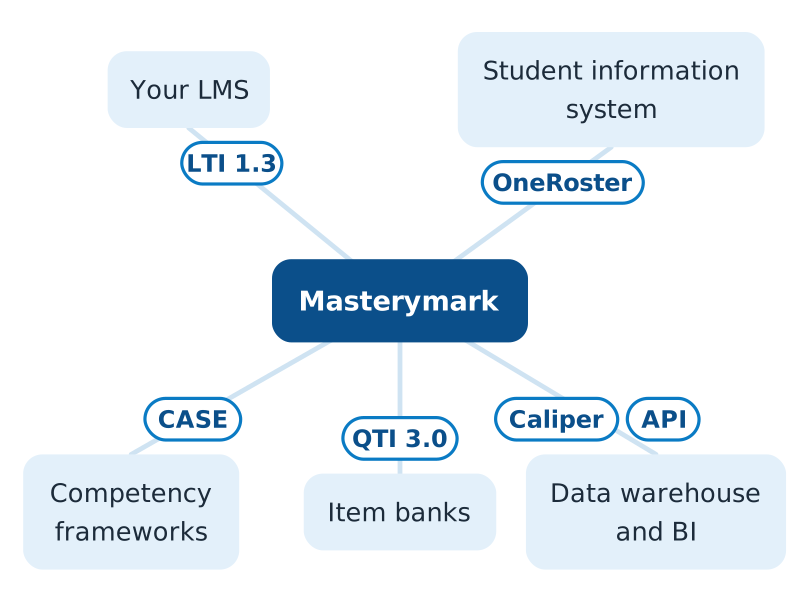
  • Frameworks in and out through CASE: EPAs, residency milestones, nursing skills matrices
  • Terms set per program: one program's committee is another's exam board
  • Progression and award outcomes computed from versioned program policies
A hub diagram with Masterymark at the center, connected to your LMS by LTI 1.3, the student information system by OneRoster, competency frameworks by CASE, item banks by QTI 3.0, and the data warehouse and BI by Caliper and API.

Evidence that adds itself up

Know who needs help while there's still time

See each learner's progress across quizzes, exams, OSCEs and clinical work in one place, so gaps surface while there's still time to act.
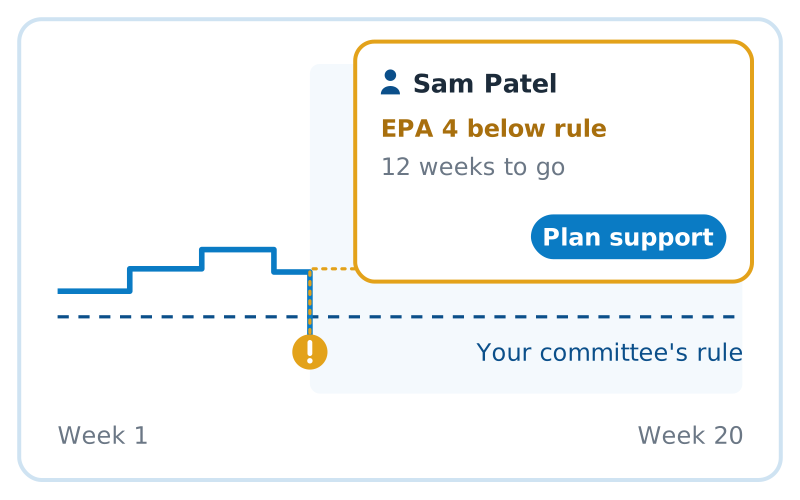
  • Sufficiency of evidence computed, not tallied by hand
  • Pathways with gates, branches and remediation loops that learners can see
  • Early warning under your committee's own rule
A term timeline from week 1 to week 20 where Sam Patel's evidence for EPA 4 drops below the committee's rule at week 8, flagged with 12 weeks still to go and an option to plan support.

In the meeting

What your committee sees

Every panel pack is built from the whole record, so the committee spends its time on judgment, not on gathering paperwork.
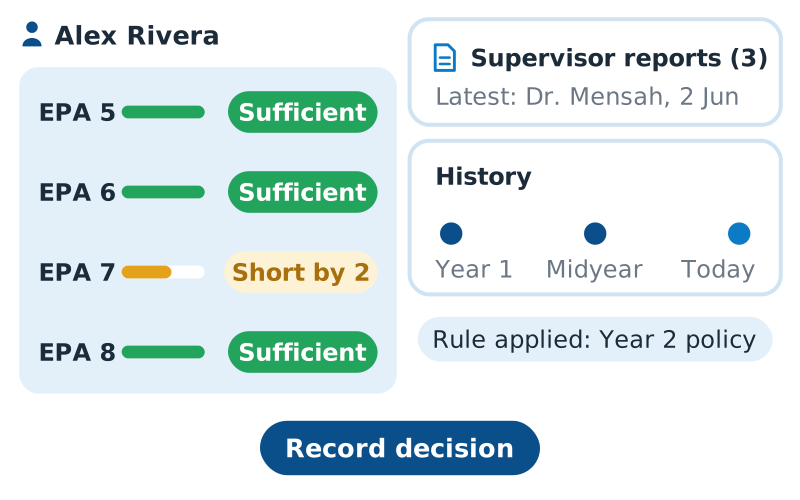
  • Evidence by EPA or outcome, with its sufficiency status
  • Supervisor reports and narrative comments, already attached
  • The rule being applied, and the learner's history against it
  • One place to record the decision and its rationale
A committee panel pack for Alex Rivera: EPAs 5 to 8 with sufficiency bars (EPA 7 short by 2, the rest sufficient), three supervisor reports (latest from Dr. Mensah), a history timeline from Year 1 to today, the Year 2 policy rule, and a Record decision button.

Decisions you can defend

A trail that holds up at appeal

Show the evidence, the rule and the approver behind every progression and award decision, whenever a learner appeals or an accreditor asks.
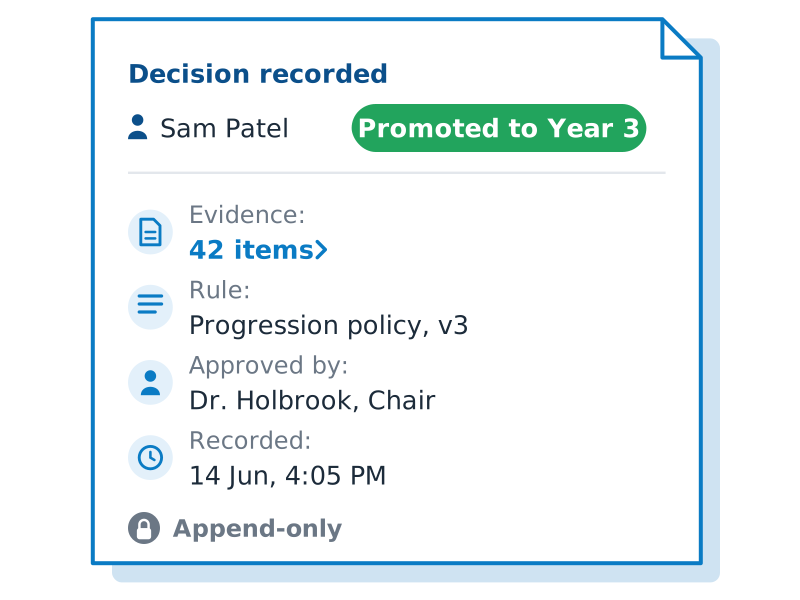
  • Results corrected, recomputed and approved in the platform
  • An append-only audit trail, so a decision years later can be reconstructed as things stood
  • AI-assisted steps logged with the model version and a named reviewer
A record of one progression decision for Sam Patel, promoted to Year 3, listing the evidence (42 items), the rule (Progression policy, v3), the approver (Dr. Holbrook, Chair) and the time recorded, marked append-only.

Your committee, your model

Works the way your committee works

Masterymark's terms and rules are settings, so it fits the committee you already run.

  • Promotions committees

    Medical school promotions and progress committees deciding who moves on, and on what evidence.

  • Clinical competency committees

    Residency program reviews of milestones and EPAs, with the evidence already assembled.

  • Annual review panels

    Year-end panels that need every assessment, report and remediation step in one pack.

  • Progression boards

    Nursing, pharmacy and other programs deciding progression under their own regulations.

Illustration

One learner, one record

One learner's year, term by term.

  1. Term 1

    Quizzes and a block exam

    Results land in the dossier, mapped to the program's framework.

  2. Term 2

    OSCE

    Station scores join the same record, on the same scoring stack as the exams.

  3. Placement

    Workplace-based assessments

    Requests go out automatically, and entrustment ratings count toward EPA targets.

  4. Mid-year

    Early warning

    Evidence for one EPA falls short, and the learner's remediation pathway opens.

  5. Year end

    Committee decision

    The panel pack is ready, and the decision is recorded with its evidence, rule and approver.

Committee questions

Questions committees ask

Can we keep our own progression rules?

Yes. Your rules are written into Masterymark as versioned program policies, and outcomes are computed from the version in force at the time.

What happens when evidence is insufficient?

Masterymark flags it under your committee's own rule, and the learner's pathway can open a remediation loop, well before the meeting.

Who approves a decision?

The approvers your program names. Each decision is recorded with its evidence, its rule and its approver.

Can a decision be reconstructed years later?

Yes. An append-only audit trail records who did what to which record, so a decision can be reconstructed exactly as things stood.

What does AI do, and what can't it do?

AI features are opt-in, and your data is never used to train AI models. AI-assisted steps are logged with the model version and a named reviewer, and no AI-proposed summative outcome is released without a person.

Be among the first to use Masterymark

Masterymark Early Access is open to colleges and universities in North America. Apply to try it with your own program's assessments, or sign up for updates.